唐伯虎点秋香
4,220-year-old rock art in SW China’s Yunnan reveals early cultural links with Southeast Asia_我的网站

A |
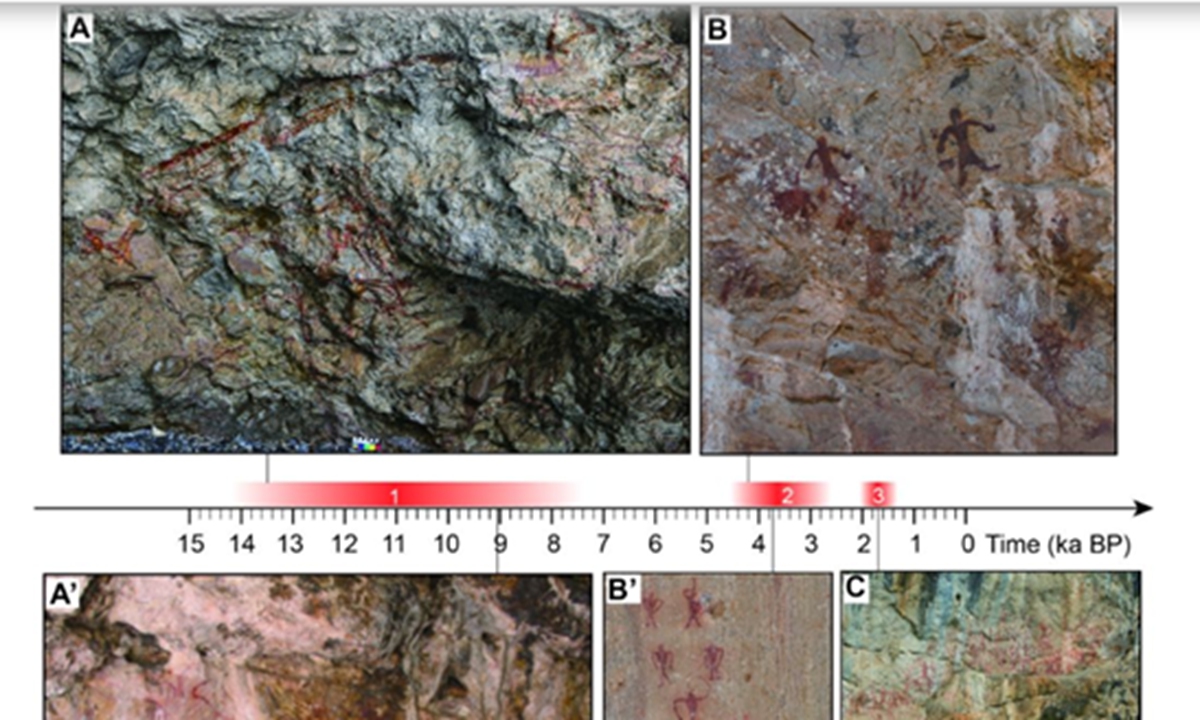
Timeline of the major painted rock art groups in Southwest China: A-A′: Jinsha River rock art; B-B′: Mangguan-Cangyuan rock art; C-C′: Zuojiang rock art Photos: Xinhua
Chinese researchers have obtained the first absolute dates for rock paintings at the Mangguan rock art site in Southwest China's Yunnan Province, pushing the known history of rock art created by prehistoric settled communities in the region back to about 4,220 years ago. The paintings also suggest cultural interactions more than 4,000 years ago between Southwest China and civilizations along the Yellow and Yangtze rivers, as well as possible exchanges with neighboring parts of Southeast Asia, including present-day Myanmar, Thailand and Vietnam, a member of the research team told the Global Times.
The Yunnan Provincial Institute of Cultural Relics and Archaeology, in collaboration with Nanjing Normal University and other institutions, have recently made a significant archaeological breakthrough. Through systematic surveys and uranium-thorium (U-Th) dating at the Mangguan site in Gengma county, the research team obtained the first absolute dates for the site's rock paintings, tracing rock art created by prehistoric settled communities back to around 4,220 years ago.
The findings were recently published in the international journal
Journal of Archaeological Science: Reports.
The Mangguan rock paintings represent one of the best-preserved prehistoric rock art sites in Yunnan. The research team presented high precision U Th dating of carbonate accretions that stratigraphically overlie the painted motifs at the Mangguan site, according to the paper published in the journal.
The dating results show that carbonate deposits overlying a human figure yielded a corrected age of 4,240 ± 19 years before present, confirming that ancient people living in the region had already produced mature figurative art at least 4,220 years ago, Wu Yun, first author of the paper and an associate researcher at the Yunnan Provincial Institute of Cultural Relics and Archaeology, was cited by the Xinhua News Agency report as saying.
Dating results from 11 samples taken from different motifs clustered between about 3,907 and 3,056 years ago. By comparison, the Cangyuan cliff paintings had previously been dated to roughly 3,800 to 2,700 years ago. The Mangguan paintings are therefore significantly older, filling an important chronological gap in the region's artistic record before the Cangyuan phase.
Shao Qingfeng, corresponding author of the paper and a professor at the School of Geography at Nanjing Normal University, told the Global Times that previous estimates dated the Mangguan rock paintings to a little over 3,000 years ago based mainly on imagery and comparisons with similar regional sites. Using microsamples of secondary carbonate deposits overlying the paintings, researchers have now obtained a precise minimum age of about 4,220 years before present without damaging the rock art.
The findings and the establishment of this chronological framework not only strengthen the archaeological foundation for studying rock art in Southwest China, but also provide a direct reference for rock art sites across Southeast Asia that have yet to undergo systematic dating, Shao said.
The findings may also challenge long-held perceptions of Southwest China around 4,200 years ago - roughly the era of the Xia Dynasty (c.2070 BC-C.1600 BC) - and help fill a key gap in understanding the pluralistic yet integrated development of Chinese civilization.
Shao said that while academic research has traditionally focused on the Yellow River and Yangtze River basins as cradles of early Chinese civilization, sites such as Mangguan and Cangyuan show that stable and culturally active communities also thrived in mountainous Southwest China. The newly established rock-art chronology brings an artistic dimension to the broader narrative of China's enduring cultural development.
Moreover, stylistic similarities suggest that Southwest China maintained exchanges with the Yellow River and Yangtze River regions and with early societies in Southeast Asia, providing material evidence of cross-regional interaction more than 4,000 years ago.
。
到2030年,社会消费品零售总额达到60万亿元左右 5年10万亿元消费增量有支撑 作为消费领域首份国家级专项规划,《扩大消费“十五五”规划》(以下简称《规划》)提出到2030年消费市场发展目标:消费市场总体规模持续扩大,社会消费品零售总额达到60万亿元左右。

B | 2025年,我国社会消费品零售总额达50.12万亿元,连续多年稳居全球第二大商品消费市场和第一大网络零售市场。 按照目标,未来5年,社会消费品零售总额将有10万亿元左右增量。实现增量目标的支撑条件如何?怎样实现增量目标?记者进行了采访。 增量目标具备坚实支撑条件和较强可操作性 夜幕降临,重庆长嘉汇购物公园热闹起来,一场科技与文化交织的无人机灯光秀上演。花朵、熊猫、山水等图案轮番呈现,为这座城市增添几分浪漫。

C | “和家人看完无人机表演再吃顿火锅,晚上都安排满了。

D | ”游客彭尚文说,吃完饭还要去商圈选购文创商品。

E | 去年4月以来,无人机灯光秀已展演100余场,全网传播量约110亿次,串联起餐饮、零售等消费链条。该商圈一家店铺的经营者介绍,在夏季夜间展演时段,门店客流量比平日提升三成,整体营业额大幅上涨。流量转变为实实在在的增量,成为消费活力迸发的生动写照。 商务部研究院流通与消费研究所副研究员姜照认为,《规划》提出到2030年社会消费品零售总额达到60万亿元左右,是在2025年首次突破50万亿元大关基础上设定的预期性目标,具备坚实支撑条件和较强可操作性。 消费市场底盘稳固—— “十四五”时期,尽管外部环境复杂严峻,但消费市场总体保持增长。我国社会消费品零售总额相继跃上40万亿元、45万亿元和50万亿元台阶,5年间增长超10万亿元。最终消费支出对经济增长的平均贡献率达58.8%,比“十三五”时期提高10个百分点。 智能家居、智能机器人等新产品进入市场,技术迭代升级,供需更好适配,逐渐进入千家万户;县域市场以及银发、青年、婴童等消费群体体量庞大,消费增长前景广阔……参照“十四五”时期的增长规模,这一目标积极可行。 国家发展改革委有关负责同志表示,面向“十五五”,我国消费市场发展进入提质扩量的关键时期,消费基础稳固扎实、消费升级趋势明显、消费场景创新活力充足,为消费市场壮大提供坚实支撑。 政策举措接续发力—— 7月8日,2026年全国暑期文化和旅游消费季启动。消费季期间,各地将举办超3万场次文旅消费活动,发放超4.5亿元消费券等消费补贴,助力居民游客欢度暑期。

F | 近年来,提振消费专项行动、消费品以旧换新、国际消费中心城市培育建设、个人消费贷款财政贴息、有奖发票活动等促进消费政策落地实施,成效持续显现。 2025年,以旧换新相关商品销售额超过2.6万亿元,惠及消费者超3.6亿人次,带动社会消费品零售总额增长超1个百分点。今年上半年,消费品以旧换新累计带动相关商品销售额1.1万亿元,惠及1.5亿人次,有力促进相关商品销售和产业发展。 今年第三批625亿元超长期特别国债支持消费品以旧换新资金已下达,政策效应持续显现;国家发展改革委正会同有关部门抓紧研究制定扩大内需战略实施方案(2026—2030年)……扩内需、促消费系列政策持续推出,将助力消费市场规模持续扩大。

G | 优化供给,形成新增长点 商品消费是促消费、惠民生的重要领域。

H | 我国商品零售额由2021年的39.4万亿元增至2025年的44.3万亿元,累计增长12.5%,占社会消费品零售总额的比重长期保持在90%左右。 《规划》突出创新引领,从推广绿色消费、提升生活类商品消费、推进“IP(知识产权)+消费”等方面,对推动商品消费扩容升级进行了系统部署。 正值暑期,江西景德镇御窑博物院迎来许多游客,研学游的学生、亲子游的家庭在文创区域认真挑选商品。 “我到每个地方旅游都会买特色文创产品。”来自浙江宁波的游客张莹刚买了一个“岁岁鸭”冰箱贴,冰箱贴外观参照馆藏文物素三彩鸭形香薰设计。“很有历史感。”张莹很满意。 围绕“岁岁鸭”IP,景德镇御窑博物院推出了180余款周边文创。院长翁彦俊介绍,博物院与设计单位合作,挖掘文物特色,不时推出新的文创产品,对于市场反馈好的会进一步规模化生产。“IP+消费”这一模式,既让更多人了解文物,也产生了经济效益。 “人工智能等技术推动商品消费迭代升级,消费新业态新模式新场景不断涌现,是持续创造增量的关键动力。”姜照分析。 上半年,社会消费品零售总额16大类商品中,10类商品实现了增长,其中7类商品的增速在5%以上。商务部有关负责同志表示,将出台相关政策措施,推动商品消费规模扩大、结构升级,更好顺应和满足人民群众多样化、多层次的消费需求。 夯实扩大消费的根基,进一步释放潜力 当前,消费领域还面临一些矛盾和问题,客观上制约着消费潜力的进一步释放。 国务院发展研究中心市场经济研究所市场流通研究室主任陈丽芬认为,《规划》更加注重提升消费能力、优化消费环境、完善促进消费制度机制等长效制度建设,强调通过多渠道促进居民增收、保障消费者权益、清理优化不合理限制性措施等举措,切实增强人们的消费意愿和消费能力,夯实扩大消费的根基。

I | 《规划》一方面坚持惠民生与促消费紧密结合,提高人民生活品质;另一方面注重处理好短期与长期、供给与需求、政府与市场、消费政策与其他经济社会政策等关系,坚持消费领域具体举措与提升消费能力、优化消费环境、健全制度政策一体推进,着力构建更加有力的政策体系。 习近平经济思想研究中心副主任王蕴认为,就业和收入既是民生大事,也是扩大消费的基础。要更加突出就业优先导向,强化就业优先政策。落实好结构性减税降费政策,支持吸纳就业能力强的产业和企业稳岗扩岗,强化包括高校毕业生在内的青年群体等重点人群就业服务和职业技能提升服务。

J | 国家发展改革委有关负责同志表示,大力提振消费,要着力提升消费能力,深入实施就业优先战略,持续开展大规模职业技能提升培训,多渠道促进居民增收,让居民消费底气更足、预期更稳、信心更强。(记者 王东辉 王 珂)。
Current article:http://obf4jny.chengjuecannaobianmouqueduoyu.shop/news/20260826_70644.html
Published on:14:18:05





 发表于 10:55:13
 QQ好友和群
 QQ空间
QQ空间 腾讯微博
腾讯微博 腾讯朋友
腾讯朋友 收藏
收藏 支持
支持 反对
反对
 发表于 05:29:19


